|
|
Books by and about 2020 presidential candidates |
|
Crippled America,
by Donald J. Trump (2015) |
United,
by Cory Booker (2016) |
The Truths We Hold,
by Kamala Harris (2019) |
Smart on Crime,
by Kamala Harris (2010) |
Guide to Political Revolution,
by Bernie Sanders (2017) |
Where We Go From Here,
by Bernie Sanders (2018) |
Promise Me, Dad ,
by Joe Biden (2017) |
Conscience of a Conservative,
by Jeff Flake (2017) |
Two Paths,
by Gov. John Kasich (2017) |
Every Other Monday,
by Rep. John Kasich (2010) |
Courage is Contagious,
by John Kasich (1998) |
Shortest Way Home,
by Pete Buttigieg (2019) |
The Book of Joe ,
by Jeff Wilser (2019; biography of Joe Biden) |
Becoming,
by Michelle Obama (2018) |
Our Revolution,
by Bernie Sanders (2016) |
This Fight Is Our Fight,
by Elizabeth Warren (2017) |
Higher Loyalty,
by James Comey (2018) |
The Making of Donald Trump,
by David Cay Johnston (2017) |
|
Books by and about the 2016 presidential election |
|
What Happened ,
by Hillary Clinton (2017) |
Higher Loyalty ,
by James Comey (2018) |
Trump vs. Hillary On The Issues ,
by Jesse Gordon (2016) |
Hard Choices,
by Hillary Clinton (2014) |
Becoming ,
by Michelle Obama (2018) |
Outsider in the White House,
by Bernie Sanders (2015) |
|
|
Book Reviews |
(from Amazon.com) |
(click a book cover for a review or other books by or about the presidency from Amazon.com)
|
Crashing the Party:
How to Tell the Truth and Still Run for President
Taking on Corporate Governance in an Age of Surrender, by Ralph Nader
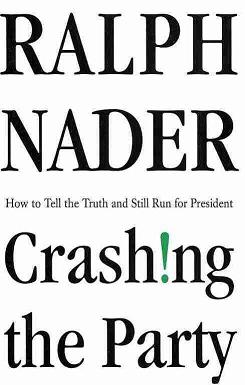
(Click for Amazon book review)
BOOK REVIEW by OnTheIssues.org:
This book is Nader's post-2000 analysis of why he ran for president, and how the media and the two major parties viewed his run.
It is the definitive explanation of Nader's reasoning -- in all the necessary detail -- yet mainstream media still question Nader's motivations as if this book did not exist to explain it without their guessing.
And indeed, that is a large part of the reason Nader ran in 2000 -- because the mainstream media will not read his books, but instead ask him only about the horserace aspects of running, and participate in keeping Nader and other third-party candidates from running.
Nader's reasons for running are all laid out here -- we try to order them in what we think Nader ranks their importance:
- Nader sees a "democracy gap" where citizens no longer have a substantial voice, as illustrated by his announcement speech (p. 326-327)
- Nader blames corporate influence for the lack of a voice for citizens, with complicity by both the government and the two major parties, as illustrated in his critique of corporations (p. 36)
- Nader sees the Democratic Party as having lost touch with its progressive roots, as illustrated in his condemnation of the lack of progressive values in the 2000 Democratic Party Platform (p. 12-13)
- Nader sees the "Commission on Presidential Debates" (which despite its high-sounding name, is actually a private corporation run jointly by the Democrats and Republicans) as a primary culprit in blocking access to a serious debate durnig the presidential race, as illustrated in his critique of the CPD (p. 223-227)
|
To anyone who was willing to listen, Nader made clear those 4 critiques during the 2000 presidential race.
But his run in 2004 caused many former supporters (including myself, in the interest of full disclosure) to stop being willing to listen.
Many otherwise progressive-minded people in 2004 started considering Nader a political activist rather than a consumer activist -- and hence neglected his long and worthwhile history of accomplishments.
So why run again in 2008? Nader will sue (as he did in 2004) to get into the Presidential debates -- in part, he considers himself the "point man" to push for a more open political dialogue. As Nader ages (he's now 74 years old), he wants to prepare the playing field for his successors. Nader is in a unique position to attack the problems in the political system that keep out people like him -- so attacking them now means more people like him can have a voice, and have political accomplishments like Nader's, well into the future.
I consider that the psychological basis for Nader's running in 2008. I think he sees himself as the American Socrates -- his elder years spent pin-pricking the system to remind them what is wrong. For those of you who don't quite recall Plato's Dialogues from high school, I've prepared a comparison chart:
| Socrates
| Nader |
| Socrates was accused of impiety and corrupting the youth of Athens, which in practice meant he was annoying the citizenry by pointing out their problems, and they wanted him to just stop.
| Nader was accused of causing Bush to win the 2000 election, which in practice meant he was annoying the citizenry by pointing out the problems of the two-party system, and the two parties (and later the citizenry as a whole) wanted him to just stop.
| | Socrates was judged guilty by a majority of a jury of his peers. As punishment, Socrates suggested he be rewarded with free dinners.
| Nader was judged guilty of being a spoiler by the majority of progressives who voted for him in 2000. Nader, in response, ran again in 2004, as unapologetically as Socrates mocked his verdict.
| | Socrates was sentenced to death. Socrates' judge really meant for Socrates to take the judgment seriously and leave Athens.
| Nader was sentenced to political death in 2004 by his former progressive constituency, receiving only 463,000 votes compared to the 2.9 million he received in 2000. Nader's former constituents really meant for Nader to take seriously their pleas to leave politics.
| | Socrates was offered an escape into exile, widely believed to have been allowed by the authorities, right before his execution. Socrates refused on principle to escape, even when the prison door was open.
| Nader was offered an escape from political death by endorsing Gore at the last minute in 2000, and/or Kerry at the last minute in 2004. Nader refused on principle to back down, even when an honorable way out was offered.
| | Socrates carried out his own execution because he believed in obeying the law, above his own life.
| Nader similarly believed in 2000 and 2004 in serving out the wishes of his supporters, whom, Nader claimed, did not support him so he could endorse someone else at the last minute.
| | Socrates died, but the story of his trial and execution (Plato's Dialogues) became his most lasting legacy.
| Nader lost badly in 2004, and will likely lose even more badly in 2008, but the story of his persistent principled struggle may too become his most lasting legacy.
|
Well, that's just my take -- whether Nader thinks about Socrates I'm not so sure. But he certainly thinks a lot about principles -- as Socrates did -- and to understand Nader's choices in 2008, one must think about those same principles. Nader's principles as applied to non-politics are frequently forgotten in the helter-skelter of presidential politics. If you need some reminding of them, read the excerpts of this book.
-- Jesse Gordon, jesse@OnTheIssues.org, April 2008
| OnTheIssues.org excerpts: (click on issues for details)
|
Abortion
Ralph Nader: Roe v. Wade is not at risk, even from GOP Supreme Court.
|
Civil Rights
Ralph Nader: Questioned anti-female bias at 1950s Harvard Law School.
|
Corporations
Bill Clinton: OpEd: Pushed corporate-inspired bills on telecomm & trade.
Rev. Jesse Jackson: Use corporate power to open doors to black businesses.
Ralph Nader: Corporate politics is only free speech because money talks.
Ralph Nader: Major parties both focus on wealthy interests.
Ralph Nader: Airline industry took $15B advantage of 9-11.
Ralph Nader: 1965 book "Unsafe At Any Speed" saved millions of lives.
|
Drugs
Gary Johnson: Other governors privately support ending drug war.
|
Education
Ralph Nader: Standardized tests designed to show public schools failing.
|
Environment
Ralph Nader: Dems surrendered to the auto industry on safety & pollution.
|
Free Trade
Dick Gephardt: No MFN for China; keep annual review.
Ralph Nader: Corporate globalism causes autocratic governance.
|
Government Reform
Jesse Ventura: Credits win to public financing & same-day registration.
Joseph Lieberman: Tort law is an out-of-control lottery.
Ralph Nader: Denying D.C. vote is colonial mentality by congress.
Ralph Nader: Clean money means clean elections.
Ralph Nader: Government obstacles to voting make our elections oppressive.
Ralph Nader: Lack of election opponents let corrupt pols stay in office.
Ralph Nader: Non-violent demonstrations are ignored by the press.
Ralph Nader: National Youth Convention bypasses electoral fluff and bluff.
Ralph Nader: Dems & GOP say they want campaign reform, but do nothing.
Ralph Nader: Citizens should shape elections, not just spectate and vote.
Ralph Nader: Binding "None Of The Above" disqualifies election if it wins.
Ralph Nader: FEC regulations prevent 3rd-party campaigns.
Ralph Nader: Ballot access restrictions set up as barriers to 3rd parties.
|
Health Care
Al Gore: 1999: Pushed South Africa to respect Big Pharma AIDS patent.
Ralph Nader: Military development of cheap vaccines shows up Big Pharma.
|
Homeland Security
Ralph Nader: Bush attacks civil liberties while saying he defends them.
|
Principles & Values
Al Gore: 1997: Refused to meet with Ralph Nader to discuss issues.
Jimmy Carter: Preconditions for fair elections not present in 2000 Florida.
John McCain: 2000: Decried "incumbency protection racket" then lost to it.
Maria Cantwell: Green turnout for Nader had positive effect on her election.
Ralph Nader: Joe Lieberman was unwise VP choice for Gore.
Rev. Jesse Jackson: 1995: A third party may be needed for progressives.
Rev. Jesse Jackson: Opposed bipartisan conservative majority that ignored him.
Robert Reich: Democratic Party is dead as a doornail.
Tom DeLay: 1995: Page 1 expose in Washington Post about lobbyist money.
Ralph Nader: Gore & Bush both ignore youth issues in favor of fat cats.
Ralph Nader: 1960s participatory citizens shut out by 1990s corporations.
Ralph Nader: Ran in 2000 to address the "democracy gap".
Ralph Nader: Suffered from "media gap"--little coverage of 3rd parties.
Ralph Nader: Base campaigns on issues, not on ego.
Ralph Nader: News media doesn't cover 3rd parties; only the horse race.
|
Social Security
Ralph Nader: Candidates focus on elderly because young people don’t vote.
|
Technology
Ross Perot: 1992: 30-minute TV spots shook establishment; banned in 1996.
Ralph Nader: Media coverage moving from sound bites to sound barks.
Ralph Nader: Internet encourages small donations but not voter turnout.
Ralph Nader: TV news is sparse, abbreviated, and very repetitious.
Ralph Nader: FCC gave away $70B of spectrum but blocked non-profits.
|
War & Peace
Noam Chomsky: Opposed Vietnam War, but TV only covered sound bites.
|
Welfare & Poverty
Ralph Nader: Visit poor cities to put faces on poverty statistics.
Ralph Nader: Predatory lending is rich scamming the poor.
Ralph Nader: Tale of Two Cities: lovely suburbs and poor inner cities.
|
The above quotations are from Crashing the Party:
How to Tell the Truth and Still Run for President
Taking on Corporate Governance in an Age of Surrender, by Ralph Nader.
Related books, debates, and candidates:
- Seventeen Traditions, by Ralph Nader
- The Good Fight: Declare Your Independence and Close the Democracy Gap, by Ralph Nader
- Nader: Crusader, Spoiler, Icon, by Justin Martin
- Crashing the Party: How to Tell the Truth and Still Run for President, by Ralph Nader
- The Avocado Declaration, by Peter Miguel Camejo
- The Concord Principles, by Ralph Nader
- Cutting Corporate Welfare, by Ralph Nader
- Buchanan debates Nader
- In the Public Interest columns, by Ralph Nader
|
|