|
|
Books by and about 2020 presidential candidates |
|
Crippled America,
by Donald J. Trump (2015) |
United,
by Cory Booker (2016) |
The Truths We Hold,
by Kamala Harris (2019) |
Smart on Crime,
by Kamala Harris (2010) |
Guide to Political Revolution,
by Bernie Sanders (2017) |
Where We Go From Here,
by Bernie Sanders (2018) |
Promise Me, Dad ,
by Joe Biden (2017) |
Conscience of a Conservative,
by Jeff Flake (2017) |
Two Paths,
by Gov. John Kasich (2017) |
Every Other Monday,
by Rep. John Kasich (2010) |
Courage is Contagious,
by John Kasich (1998) |
Shortest Way Home,
by Pete Buttigieg (2019) |
The Book of Joe ,
by Jeff Wilser (2019; biography of Joe Biden) |
Becoming,
by Michelle Obama (2018) |
Our Revolution,
by Bernie Sanders (2016) |
This Fight Is Our Fight,
by Elizabeth Warren (2017) |
Higher Loyalty,
by James Comey (2018) |
The Making of Donald Trump,
by David Cay Johnston (2017) |
|
Books by and about the 2016 presidential election |
|
What Happened ,
by Hillary Clinton (2017) |
Higher Loyalty ,
by James Comey (2018) |
Trump vs. Hillary On The Issues ,
by Jesse Gordon (2016) |
Hard Choices,
by Hillary Clinton (2014) |
Becoming ,
by Michelle Obama (2018) |
Outsider in the White House,
by Bernie Sanders (2015) |
|
|
Book Reviews |
(from Amazon.com) |
(click a book cover for a review or other books by or about the presidency from Amazon.com)
|
The Faith of Condoleezza Rice
by Leslie Montgomery
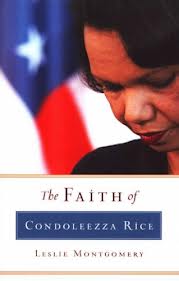
(Click for Amazon book review)
Click here for 26 full quotes from Condoleezza Rice in the book The Faith of Condi Rice, by Leslie Montgomery.
Click here for 1 full quotes from New Testament in the book The Faith of Condi Rice, by Leslie Montgomery.
OR click on an issue category below for a subset. |
OnTheIssues.org BOOK REVIEW:
This book is not a political biography, but a faith-based biography. It focuses on the basis of Condi's faith (primarily from her pastor father, John Rice) and then on how Condi applies that faith to public policy decisions. The book details her early childhood in segregated Alabama in the 1950s and 1960s, and follows Condi's career through college and to George W. Bush's Cabinet. The thesis of the book is presented on the opening page of chapter 1:
Condoleezza's impenetrable strength, mysterious balance, and unshakable temperament are all evidence of three defining characteristics--a faith that runs deep in her heritage, a personal passion for God that runs thick through her veins, and moral convictions that are by-products of both.
|
The author spends the rest of the book validating that thesis, and for the most part succeeds. That success, however, only reflects the limited scope of the title -- yes, Condi's faith is important to understanding Condi, but Condi's politics is important also. As the author asserts on pg. 16, "This book is not about politics" -- but of course readers want to know about the politics! Unfortunately, the author does not know politics very well at all -- the author is an editor for the American Association of Christian Counselors and a writer for "Focus on the Family." That makes her eminently qualified to write a book about faith, but her lack of political understanding severely limits the value of this book.
The examples of lack of political understanding come early and often, starting in chapter one, where the author asserts that "in 1863, President Lincoln, a slave owner himself, issued the Emancipation Proclamation" (p. 17). Huh? Lincoln owned slaves? That was the most important political issue of the Civil War, so certainly a politically astute writer would know that. Just in case, I checked the Internet, and indeed there are lots of conspiracy theories that Lincoln owned slaves, including one current book entitled Did Lincoln Own Slaves?. (The answer to that book's title question is No, and that author says it's just a dumb question that people insist on asking, despite a total lack of any evidence). That glaring inaccuracy calls into question the accuracy of the rest of the book's historical and political analysis.
You might say, "Well, knowing about Lincoln is really about history, not about politics." True, but the purpose of citing historical context is to understand Condi's roots and Condi's milieu. The author says exactly that in the follow-up to the thesis excerpt above:
To know and appreciate the faith of Condoleezza Rice, no matter what your religious preference, you must learn about hers. To understand her passion for peace, you must become personally familiar with the chaotic state of the nation in which she was born. To fully grasp her heart and what has motivated her to exceed the limited expectations that enslaved both her race and her gender for hundreds of generations before her, you must examine her roots.
|
The problem is that this author does well in explaining the religious preference aspects, but does poorly in explaining the "chaotic state of the nation" (political aspects) and in "examining her roots" (historical aspects). Heck, even that phrase "hundreds of generations" is just factually incorrect -- Africans were enslaved in the Americas for a dozen generations, not hundreds! Perhaps women were limited for hundreds of generations, but this book presents no evidence that Condi's character was formed by the women's rights movement (alongside much evidence that Condi's character was formed by the civil rights movement, e.g. p. 36, p. 40, p. 47, p. 58, p. 61, p. 77, p. 94).
Nevertheless, the author does present a solid study of the history of the civil rights movement, as the formative background milieu of Condi's childhood. Applying historical context to one person's development is a meaningful and unusual analysis, and to that extent the civil rights history is valid. For example, Condi was near enough to have felt the explosion the infamous Birmingham church bombing (the 1963 event in which four young black choir girls were killed in Birmingham Alabama by a white racist's bomb). Condi's memory of that event -- and her personal recollection of her feelings associated with it -- are certainly important for understanding her adult character.
But the author insists on cataloguing just about EVERY major event of the civil rights movement, whether Condi was affected by it or not. For example, the author describes how, in 1977, the United States Postal Service issued the first commemorative stamps about Black Heritage (p. 109). The author notes that Condi was 23 years old and beginning work on her PhD at that time -- but there is no comment by Condi on the relevance of those stamps, nor even if Condi was aware of their existence. So why mention them? The same applies to the Rodney King beating and subsequent Los Angeles riots in 1991 (Condi was in Stanford then, hundreds of miles away) -- and to dozens of other historical references which seems unconnected to Condi's life. It feels like the author did the historical research (solid); then interviewed Condi (interesting); then connected the relevant historical parts to Condi's character (purposeful); but then left in the book all of the irrelevant parts that should have been removed.
While the civil rights history has at least one purpose -- that it is an unusual history that many readers are unfamiliar with -- the author does the same with political history -- which is the typical means of presenting history, and hence offers nothing new to the reader. The author presents numerous aspects of current events as Condi became more involved with politics and government -- but again, numerous irrelevancies remain disconnected with the political history as much as with the civil rights history. For example, the author details the 1993 World Trade Center bombings (pp. 151-2) but connects that to Condi only by noting that at that time Condi was provost at Stanford University. Condi offeres no comment on the bombings; had nothing to do with the response to the bombing; and there's nowhere later in the book that readers might refer back to the bombing as the basis for Condi's later policy choice -- so why include it at all?
Readers are left to their own devices to determine whether an historical episode relates to Condi or not. I took to scanning ahead to see if Condi would offer a comment, before committing myself to reading, say, two pages about the 1993 WTC bombing. If Condi is not mentioned, I just felt misled by the author into a tangential area that would be better avoided. In summary, this book is great for understanding Condi's faith -- but is awful for understanding Condi's history or Condi's politics.
-- Jesse Gordon, editor-in-chief, OnTheIssues.org, January 2013
| OnTheIssues.org excerpts: (click on issues for details)
|
Civil Rights
No marches as child; but one-on-one mentoring instead.
Tested Civil Rights Act by eating at all-white restaurant.
Childhood in the heat of the Civil Rights struggle.
I grew up in Birmingham, most segregated city in America.
I remember "Bombingham", city of Bull Connor and the KKK.
Founding Fathers said "We the People," but didn't mean me.
Missed 31 days of school in 1963 due to Birmingham bombings.
Furious at theories that blacks have genetically lower IQ.
|
Education
Under segregation, blacks prepared for integrated college.
|
Families & Children
I didn't start out not to get married & have kids.
|
Foreign Policy
1970s: Adopted Russian culture; learned Russian; read Pravda.
|
Health Care
2001: Breast cancer scare from exam; mother died of it.
|
Homeland Security
As child in 1962, felt danger of Cuban Missile Crisis.
|
Principles & Values
OpEd: Faith & heritage tied in personal passion for God.
Tested with genius IQ and skipped first grade.
Grieving is a privilege; optimistic in face of suffering.
Rejoice in our suffering; endurance produces character.
1991: Considered for Senate; but no interest in running.
Only through struggle so we realize depth of our resilience.
Considers herself an evangelical "contagious Christian".
Legislating morality is browbeating about faith.
Not a day of my life have I doubted the existence of God.
Descended from black slaves and white slave owners.
Father, John, initiated church's community "Youth Night".
Baptized by her father at Westminster Presbyterian Church.
First classical piano recital at age four.
1967: Moved from Alabama to integrated middle-class Denver.
|
The above quotations are from The Faith of Condoleezza Rice
by Leslie Montgomery.
Political Biographies focusing on Faith:
- Pope Francis's main political issues page
- Political characterization of the New Testament
- Political characterization of the Old Testament
- God and Hillary Clinton, by Paul Kengor
- The FAITH of Barack Obama, by Stephen Mansfield, Aug. 2008
- The Mormon Faith of Mitt Romney, by Andrew Jackson, Dec. 25, 2011
- The Faith of Condoleezza Rice, by Leslie Montgomery
- The Faith of George W. Bush, by Stephen Mansfield
- The Faith & Values of Sarah Palin, by Stephen Mansfield, Oct, 2010
- Rediscovering God in America, by Newt Gingrich
|
|