|
|
Books by and about 2020 presidential candidates |
|
Crippled America,
by Donald J. Trump (2015) |
United,
by Cory Booker (2016) |
The Truths We Hold,
by Kamala Harris (2019) |
Smart on Crime,
by Kamala Harris (2010) |
Guide to Political Revolution,
by Bernie Sanders (2017) |
Where We Go From Here,
by Bernie Sanders (2018) |
Promise Me, Dad ,
by Joe Biden (2017) |
Conscience of a Conservative,
by Jeff Flake (2017) |
Two Paths,
by Gov. John Kasich (2017) |
Every Other Monday,
by Rep. John Kasich (2010) |
Courage is Contagious,
by John Kasich (1998) |
Shortest Way Home,
by Pete Buttigieg (2019) |
The Book of Joe ,
by Jeff Wilser (2019; biography of Joe Biden) |
Becoming,
by Michelle Obama (2018) |
Our Revolution,
by Bernie Sanders (2016) |
This Fight Is Our Fight,
by Elizabeth Warren (2017) |
Higher Loyalty,
by James Comey (2018) |
The Making of Donald Trump,
by David Cay Johnston (2017) |
|
Books by and about the 2016 presidential election |
|
What Happened ,
by Hillary Clinton (2017) |
Higher Loyalty ,
by James Comey (2018) |
Trump vs. Hillary On The Issues ,
by Jesse Gordon (2016) |
Hard Choices,
by Hillary Clinton (2014) |
Becoming ,
by Michelle Obama (2018) |
Outsider in the White House,
by Bernie Sanders (2015) |
|
|
Book Reviews |
(from Amazon.com) |
(click a book cover for a review or other books by or about the presidency from Amazon.com)
|
Crossroads
The Future of American Politics
by Andrew Cuomo
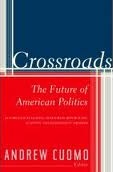
(Click for Amazon book review)
BOOK REVIEW by OnTheIssues.org:
The premise of this book is that America is at a crossroads, focusing on the then-upcoming 2004 election. Or more specifically, the premise is that Democratic Party is at a crossroads, having lost badly in the 2000 presidential election and the 2002 Congressional election, and that they'd better fix what's wrong in preparation for 2004. Cuomo got a bunch of politicians and pundits to write essays based on the premise of the "crossroad" and what path should be followed.
That premise is false. Politicians and pundits consistently pretend that each election is a "crossroad" -- each presidential election is breathlessly described by the press as "the most meaningful election of our era," until the next presidential election. The 2000 election was no crossroad -- Al Gore lost because George Bush won the Supreme Court decision about Florida. The 2002 election was no crossroad either -- the American electorate wanted to address 9/11 and elected people who they thought would best do so, regardless of party. The 2004 election, predicted in this book as the next "crossroad," ended up as assuredly no crossroad at all -- the Democrats nominated a party regular, John Kerry, who lost because he offered nothing new.
The real crossroad presidential election of our era was 1996, when Bill Clinton ran for re-election. In 1996, Clinton represented the 1960s generation whose formative issue was the Vietnam War; Bob Dole represented the "Greatest Generation" whose formative issue was WWII. Clinton won in 1992 but that election was about the economy, not about a "crossroads" choice. Pundits call Obama's election in 2008 another "crossroads," but really it was echoing the choice of 1996, whether to look forward (Obama) or look back (McCain). The 1996 election was a true "crossroad": a decision point where the American electorate first accepted post-Vietnam leadership, and also accepted that 1960s-style morality came with it.
This book unintentionally encapsulates everything that is wrong with the Democratic Party, because the party leadership accept more militarization as the solution to Bush's militarization. Even the supposedly-progressive Kathleen Kennedy Townsend mouths the standard platitude that the terrorists "hate us simply because of who we are" (p. 261; in fact, they hate us because we have military bases in Muslim areas). That's not leadership -- it's condescension. Those sorts of platitudes are dangerous because they lead to a self-perpetuating, downwardly-spiraling set of policies: More "security" (that means more military spending; Joe Lieberman's chapter), more "unity" (that means less dissent; John Edwards' chapter), more patriotism (more condescending platitudes; Kerry's chapter), more moderation (less dissent, again, under the guise of bipartisanship; Mike Castle's chapter); in other words, more of the same.
All of those Democrats justify that Bush was right about Iraq. It's easy from 2013 to make a retrospective "told-you-so", now that the majority of Americans acknowledge that Bush lied to America about the need for war -- but many millions of Americans said so in 2003, and were ignored by the Democratic Party, while those millions went begging for political representation. The real "crossroad" would have been if the Democrats nominated someone in 2004 who admitted that the Iraq War was a terrible mistake and we should get out -- that would have meant that presidential aspirants forever forward had to listen to the American people and that presidents could no longer lie to the American people. That crossroad did not happen in 2004 and has not happened since.
There are dissenting voices in this book: Howard Dean, who based his 2004 campaign on Iraq War dissent; Al Sharpton, who has spent his career arguing against moderate equivocation; Carol Moseley-Braun and Jesse Jackson Jr., who both argue for expanding the electorate to include unheard voices. But those voices are well outside the mainstream of the Democratic Party, and hence simply illustrate how that mainstream just doesn't get it. The purpose of this book was to describe how Democrats could win in 2004, but instead it highlighted exactly why they were doomed to lose.
Finally, let's examine Cuomo himself, who put together the whole book (which included selecting the contributors). Which side is he on? The moderate go-along-to-get-along mainstream, or the meaningless extremists arguing for honesty, democracy, and justice? Well, Cuomo tries to bridge the divide. He says that Democrats should have questioned Bush on the Iraq War (p. 60), and that Democrats should aggressively push for justice (pp. 63ff). He acknowledges that "a progressive approach challenges power structures and mediocrity" (p. 81). But then he selects Kerry and Edwards and Lieberman as the spokesmen for the party -- which endorses being un-aggressive, un-questioning, un-progressive -- and un-winnable in presidential elections.
If Cuomo, as editor, wanted to make the progressive case, he could have said, "Kerry and Edwards and Lieberman represent what is wrong with the Democratic Party" (which most progressives believe, like Dean and Sharpton and Moseley-Braun). Maybe he didn't say that because he acknowledged that those three were the frontrunners for the 2004 nomination. Or maybe he just meant to present both sides and let the reader decide -- but that goes against his own essay, in which he argues for being "aggressive progressives." Cuomo is on the short list for the progressive mantle in the 2016 presidential race. It's unclear from this book whether he will run as a progressive or as just another mainstream party apparatchik. But this book certainly does clarify both sides of that crossroad.
-- Jesse Gordon, editor-in-chief, OnTheIssues.org, Jan. 2013
| OnTheIssues.org excerpts: (click on issues for details)
|
Civil Rights
Al Sharpton: No equivocation on racism, sexism, and homophobia.
Andrew Cuomo: Our housing stock remains largely segregated.
Carol Moseley-Braun: Empowerment of women is not a zero-sum game.
|
Corporations
Al Sharpton: Federal enforcement of big business regulation.
Democratic Party: Government counters the concentration of economic power.
|
Education
Andrew Cuomo: Vouchers undermine existing public schools.
Andrew Cuomo: Universal 3-K: pre-school for all 3-year-olds.
Democratic Party: Democrats are the party of public education.
John Edwards: America has 2 school systems, divided by income over race.
|
Energy & Oil
Andrew Cuomo: Repower old power plants to increase efficiency.
Andrew Cuomo: Our consumption of fossil fuels causes permanent changes.
Bill Clinton: $1 trillion global market for clean energy.
|
Environment
Andrew Cuomo: Make a U-turn on development highway, towards sustainability.
|
Families & Children
Bill Clinton: Family and Medical Leave Act: pro-family & pro-work.
|
Foreign Policy
Howard Dean: Marshall Plan did as much for security as any martial plans.
John Kerry: Enlist allies through strength of ideas, not just arms.
|
Free Trade
Mary Landrieu: Kill secret deal to import Mexican sugar.
|
Government Reform
Andrew Cuomo: Admit when programs become wasteful, and reform them.
Andrew Cuomo: 10% consolidation tax credit for merging counties.
Andrew Cuomo: Free air time for all candidates, to level the playing field.
Jesse Louis Jackson: How do we appeal to the 100 million who don't vote?
Jesse Louis Jackson: Voting-rights amendment to the Constitution.
|
Homeland Security
Al Sharpton: Protect American rights; question the Patriot Act.
Andrew Cuomo: Dubious about new power to interrogate and detain.
Bill Clinton: Better to be wrong & strong than weak & right.
Joseph Lieberman: War against terrorism should use both swords & ploughshares.
Kathleen Kennedy Townsend: Threat is from WMDs by those who hate who we are.
Kathleen Kennedy Townsend: Protect ourselves from threats from abroad.
Nancy Pelosi: Protect our precious homeland from threat of terrorism.
|
Immigration
Mario Cuomo: Diversity is strength and not a weakness.
|
Jobs
Andrew Cuomo: Labor unions protect fairness at negotiation table.
Dick Gephardt: Son of Teamster and a secretary.
|
Principles & Values
Al Sharpton: 2 types of leaders: Thermometers measure; thermostats change.
Andrew Cuomo: To win the argument, you must make one.
Andrew Cuomo: Aggressive progressives: social/economic/racial justice.
Carol Moseley-Braun: Constitution created a republic; we have to create democracy.
Democratic Party: Safety net for no poverty & no discrimination.
Democratic Party: Democrats need bold, innovative ideas, not ideology.
J.C. Watts: Americans reject both right's moralizing & left's relativism.
James Carville: 2002: We've got to stand FOR something.
Mary Landrieu: 2002 re-election: Dems need not concede the South to GOP.
Mary Landrieu: 2002: Invigorated campaign with old-style Bush-bashing.
Republican Party: Credo of free market economics & less government.
|
Tax Reform
Bill Clinton: Bush tax cuts are fiscally irresponsible in long run.
Kathleen Kennedy Townsend: Bush tax cuts benefit only the wealthy few.
|
War & Peace
Al Sharpton: Oppose unprovoked military action; Iraq was wrong.
Andrew Cuomo: We did not effectively question Bush on Iraq war.
Bill Clinton: Most Democrats supported Bush on Iraq.
Democratic Party: Granting open-ended authority for Iraq war lost '02 election.
Kathleen Kennedy Townsend: Stem spread of nuclear, biological, & chemical weapons.
|
Welfare & Poverty
Andrew Cuomo: Founded nation's largest provider of housing for homeless.
Bill Clinton: Keep estate tax to encourage philanthropy.
|
The above quotations are from Crossroads
The Future of American Politics
by Andrew Cuomo.
Autobiographies and Biographies of Governors:
- American Crisis, by Gov. Andrew Cuomo (D,NY)
- What A Party!, by gubernatorial candidate Terry McAuliffe (D, VA)
- The Last Line of Defense, by gubernatorial candidate Ken Cuccinelli (R, VA)
- Chris Christie: The Inside Story of His Rise to Power, by Bob Ingle and Michael Symons
- Can`t is Not an Option, by Gov. Nikki Haley, April 2012
- Governor`s Travels, by Gov. Angus King, Oct. 2010
- The Governator, by Ian Halperin (about Gov. Arnold Schwarzenegger, R-CA), Aug. 2011
- A Governor`s Story, by Jennifer Granholm (D-MI), Oct, 2005
- The Agenda for America, by Gov. Haley Barbour (R, MS), April 1996
- Blue Man in a Red State, by Greg Lemon, (about Gov. Brian Schweitzer, D, MT), June 2008
- Scorpions for Breakfast, by Gov. Jan Brewer (R, AZ), Nov. 2011
- Crossroads: The Future of American Politics, by Gov. Andrew Cuomo (D, NY), Oct. 2003
- A Reason to Believe, by Gov. Deval Patrick (D, MA), April 2011
- Against the Tide, by Gov. Lincoln Chafee (I, RI), April 2008
- Teachers Under Attack, by Mike Spina, about Gov. Chris Christie (R, NJ), Feb. 2011
Press Releases etc. from Governors, Mayors, and Justices:
- Gubernatorial Press Releases, 2019-2021
- Gubernatorial Press Releases, 2016-2019
- Gubernatorial State of the State speeches, 2019
- Gubernatorial State of the State speeches, 2018
- Gubernatorial State of the State speeches, 2017
- Gubernatorial State of the State speeches, 2016
- Gubernatorial State of the State speeches, 2011
- Gubernatorial State of the State speeches, 2010
- Mayorial State of the City speeches, 2007-2011
- Gubernatorial Press Releases, 2020
- Gubernatorial Press Releases, 2016-2019
- Gubernatorial Press Releases, 2011-2015
- Gubernatorial Press Releases, 2010
- Gubernatorial Press Releases, 2001-2009
- Gubernatorial Ad-Watch, 2018-2020
- Gubernatorial Ad-Watch, 2014-2017
- Mayoral Press Releases, 2011
- Senatorial Press Releases, 2020
- Senatorial Press Releases, 2020
- Senatorial Press Releases, 2010's
- Mayoral Campaign websites, 2011-2019
- Gubernatorial Campaign websites, 2010-2019
- Gubernatorial Campaign websites, 2010
- Gubernatorial Campaign websites, 2001-2009
- My Grandfather's Son, by Justice Clarence Thomas, Oct. 2008
|
|
|
Page last edited: Dec 16, 2018
|