|
|
Books by and about 2020 presidential candidates |
|
Crippled America,
by Donald J. Trump (2015) |
United,
by Cory Booker (2016) |
The Truths We Hold,
by Kamala Harris (2019) |
Smart on Crime,
by Kamala Harris (2010) |
Guide to Political Revolution,
by Bernie Sanders (2017) |
Where We Go From Here,
by Bernie Sanders (2018) |
Promise Me, Dad ,
by Joe Biden (2017) |
Conscience of a Conservative,
by Jeff Flake (2017) |
Two Paths,
by Gov. John Kasich (2017) |
Every Other Monday,
by Rep. John Kasich (2010) |
Courage is Contagious,
by John Kasich (1998) |
Shortest Way Home,
by Pete Buttigieg (2019) |
The Book of Joe ,
by Jeff Wilser (2019; biography of Joe Biden) |
Becoming,
by Michelle Obama (2018) |
Our Revolution,
by Bernie Sanders (2016) |
This Fight Is Our Fight,
by Elizabeth Warren (2017) |
Higher Loyalty,
by James Comey (2018) |
The Making of Donald Trump,
by David Cay Johnston (2017) |
|
Books by and about the 2016 presidential election |
|
What Happened ,
by Hillary Clinton (2017) |
Higher Loyalty ,
by James Comey (2018) |
Trump vs. Hillary On The Issues ,
by Jesse Gordon (2016) |
Hard Choices,
by Hillary Clinton (2014) |
Becoming ,
by Michelle Obama (2018) |
Outsider in the White House,
by Bernie Sanders (2015) |
|
|
Book Reviews |
(from Amazon.com) |
(click a book cover for a review or other books by or about the presidency from Amazon.com)
|
Real Change:
From the World that Fails to the World that Works, by Former Speaker of the House Newt Gingrich
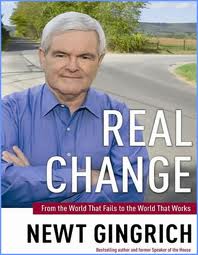
(Click for Amazon book review)
BOOK REVIEW by OnTheIssues.org:
The Republican Party has failed in implementing the Revolution of 1994, and it's time to restart that Revolution again (p. 71). At least, according to Newt Gingrich, who considers himself the architect of the Revolution of 1994. This book was written in 2009, so it's unclear whether Newt considers the Tea Party to be the new Revolution (his partner in the Revolution of 1994, Rep. Dick Armey, certainly does, as outlined in his 2010 book, Give Us Liberty). It is NOT unclear, however, that Newt considers himself to be the appropriate leader for the new Revolution.
The new Revolution is needed now, says Newt, because of the losses to Obama and the Democrats: "For a number of years I kept quiet, but the recent devastation to my party is now so great that I am compelled to speak out explicitly and decisively." (p. 24). He blames partisanship on both sides of the aisle (p. 43) for the dysfunctional state of American politics: he has one chapter entitled "An Unreformed Right: Why Republicans Can't Govern Successfully"; and another entitled "An Unreformed Left: Why Democrats Can't Deliver Real Change." The solution? Go back to the non-partisanship of the Revolution of 1994.
Citizens who actually remember the Revolution of 1994, in contrast to Newt, generally consider the era to be quite partisan. Newt DOES deserve credit for "nationalizing" the Congressional election of 1994 (getting people to vote for the Contract With America as much as just for their individual Congressional race); and he DOES deserve credit for a Revolution. But he also deserves blame for the harsh partisanship that characterized the House of Representatives in the 1990s, culminating in Bill Clinton's impeachment, arguanly the most partisan act in American history. Citizens might also contrast Newt's view with the fact that he resigned from the House speakership in the wake of a government shutdown -- also an intensely partisan act.
Nevertheless, Newt is back, and he is running for President. This book is just the first salvo in his battle for the GOP nomination. He has prepared appropriately: he formed several political organizations in the past decade to bolster his credentials on key issues (each of which gets a plug for its website, p. xxi):
- The Center for Health Transformation (www.HealthTransformation.net)
- American Solutions for Winning the Future (www.AmericanSolutions.com)
- Renewing American Leadership (ReAL, www.RenewingAmericanLeadership.com)
If Newt does enter the Republican primary, he is sure to be great entertainment. While Newt is renowned for his slightly non-mainsteream academic analysis, listeners accept it as mainstream because he delivers it with such certitude (almost always in this book, the passive voice is used, to illustrate how it's obvious that most voters are in agreement). His analysis is data-driven and historical (he's a history professor, after all), although some might call that "wonkish", a sure-fire losing attitude since Dukakis' days. Newt would call his attitude "futuristic," since his hero is still Alvin Toffler, author of "Future Shock" and "The Third Wave" (p. 65).
Whether wonkish or futuristic, Newt will be non-mainstream and hence entertaining. For example, he proposes (in the passive voice) that the US should invade Pakistan: "Afghanistan would have been dealt with in a regional context that would have included the Waziristan section of Pakistan." (p. 305). And maybe invade Syria and others too (also in the passive voice): "There would have been no free passage through Damascus for foreign terrorists to come kill Americans," but that wouldn't actually require invasions because the dictators might yield once they saw "the fury of the American people mobilized to action."
In summary, Newt positions himself as the conservative choice: more hawkish than the GOP hawks; more anti-Obama than the rest of the GOP; and more "change" than Obama ever offered. Newt will have a lot of trouble with the conservatives accepting his three divorces; he'll have even more trouble with the general electorate accepting his conversion to non-partisanship; and he'll have the most trouble of all with voters who remember him as the past generation instead of the future. But he'll be a heck of a lot of fun!
-- Jesse Gordon, editor-in-chief, OnTheIssues.org, April 2011
| OnTheIssues.org excerpts: (click on issues for details)
|
Civil Rights
George W. Bush: OpEd: Declined to address NAACP; signaled not worth dialogue.
|
Corporations
Newt Gingrich: 2002 Sarbanes-Oxley Act drives IPOs out of the US.
|
Crime
Newt Gingrich: Supports Prison Fellowship InnerChange Freedom Initiative.
Rudy Giuliani: OpEd: breakthrough on crime based on reporting right metrics.
|
Education
Arne Duncan: 2009: No new students into DC voucher program.
Newt Gingrich: More learning options: community college-run charter schools.
Newt Gingrich: Offer coupons to send kids to schools that work best.
|
Energy & Oil
Newt Gingrich: Billion-dollar prize for first mass-produced hydrogen car.
Newt Gingrich: 2008 book: Drill Here, Drill Now, Pay Less.
|
Environment
Al Gore: Sense of obligation has been replaced by individual rights.
Newt Gingrich: Katrina's collapse of New Orleans was avoidable.
Newt Gingrich: Boston's Big Dig was a classic pork barrel project.
Newt Gingrich: Reject apocalyptic warnings; they only lead to higher taxes.
|
Government Reform
Eric Holder: DC statehood is perfectly legitimate.
Newt Gingrich: End judicial supremacy; preserve our Godly heritage.
|
Health Care
Newt Gingrich: Focus on health as a moral issue.
Newt Gingrich: 21st-century personalized intelligent health system.
|
Homeland Security
Newt Gingrich: Gingrich-plus-up: $1B increase in 1990s Pentagon funding.
|
Immigration
Newt Gingrich: Deport 55,000 illegal aliens with multiple arrest records.
Newt Gingrich: Elite immigration solution incompatible with American values.
Newt Gingrich: Lax border security lets in terrorists.
Ronald Reagan: 1986: One-time amnesty for illegal aliens.
|
Jobs
Arnold Schwarzenegger: CA Governor just presides over lifetime union bureaucracies.
Newt Gingrich: Unions want to take away right to secret-ballot elections.
|
Principles & Values
Barack Obama: OpEd: Radical Spenders; Weak Defenders.
Barack Obama: OpEd: Replace red-vs.-blue politics with positive campaign.
Haley Barbour: 1994: As RNC chair, gambled on big positive ideas.
Newt Gingrich: Red-blue split in America is 85% Americans and 15% fringe.
Newt Gingrich: After 2000, Republicans failed to govern successfully.
Newt Gingrich: Red-vs.-Blue fails: propose Red-White-and-Blue solutions.
Newt Gingrich: 1979: wrote Art of Transformation; 1990s: implemented it.
Ronald Reagan: 1950s: 375 speeches as GE employee education on free markets.
|
Social Security
John Sununu: Proposed bill to invest 50% of FICA in personal accounts.
Newt Gingrich: Move retirement plans to personal savings plans.
Newt Gingrich: Invest 50% of payroll taxes in personal accounts.
Paul Ryan: Proposed bill to invest 50% of FICA in personal accounts.
|
Tax Reform
Newt Gingrich: Flat tax proposal criticized for losing popular tax breaks.
Newt Gingrich: Tax hikes retard growth and depress revenues.
Steve Forbes: Optional flat tax: 17% with $13,200 deduction.
|
Technology
Newt Gingrich: NASA bureaucrats hijacked the great space adventure.
Newt Gingrich: Establish three high-speed rail corridors; NY-MA; FL; & CA.
|
War & Peace
Newt Gingrich: Goal was to liberate Iraq from Saddam, not to occupy.
Newt Gingrich: The "Irreconcilable Wing of Islam" threatens our way of life.
|
Welfare & Poverty
Newt Gingrich: Ten Lessons from Successfully Transforming Welfare.
|
The above quotations are from Real Change:
From the World that Fails to the World that Works, by Former Speaker of the House Newt Gingrich.
Autobiographies for 2012 GOP primary candidates:
- No Apology, by Gov. Mitt Romney, Mar 2, 2010
- Real Change, by Speaker Newt Gingrich, Dec 18, 2007
Biographies:
- CEO of SELF, by Herman Cain, 2001
- Joe Biden: A Life of Trial and Redemption, by Jules Witcover, 2010
- Rick Santorum: A Senator Speaks Out on Life, Freedom, and Responsibility, 2005
- Michele Bachmann: Why She Will Win, by Ron Paul Jones, 2011
- A Mormon in the White House? 10 Things Every American Should Know about Mitt Romney, by Hugh Hewitt
- Mitt Romney: The Man, His Values and His Vision, by Lisa Ray Turner and Kimberly Field
- Deliver Us from Evil, by Sean Hannity
|
Policy books:
- Confidence Men, by Ron Suskind, 2011
- Core of Conviction, by Rep. Michele Bachmann, 2011
- It Takes a Family, by Sen. Rick Santorum, 2005
- On My Honor, by Gov. Rick Perry, 2008
- End The Fed, by Rep. Ron Paul, Sep 16, 2009
- Gold, Peace, and Prosperity: The Birth of a New Currency, by Ron Paul, 2007
- My Journey to the White House, by Herman Cain, 2011
|
|
|
Page last edited: Feb 21, 2019
|