|
|
Books by and about 2020 presidential candidates |
|
Crippled America,
by Donald J. Trump (2015) |
United,
by Cory Booker (2016) |
The Truths We Hold,
by Kamala Harris (2019) |
Smart on Crime,
by Kamala Harris (2010) |
Guide to Political Revolution,
by Bernie Sanders (2017) |
Where We Go From Here,
by Bernie Sanders (2018) |
Promise Me, Dad ,
by Joe Biden (2017) |
Conscience of a Conservative,
by Jeff Flake (2017) |
Two Paths,
by Gov. John Kasich (2017) |
Every Other Monday,
by Rep. John Kasich (2010) |
Courage is Contagious,
by John Kasich (1998) |
Shortest Way Home,
by Pete Buttigieg (2019) |
The Book of Joe ,
by Jeff Wilser (2019; biography of Joe Biden) |
Becoming,
by Michelle Obama (2018) |
Our Revolution,
by Bernie Sanders (2016) |
This Fight Is Our Fight,
by Elizabeth Warren (2017) |
Higher Loyalty,
by James Comey (2018) |
The Making of Donald Trump,
by David Cay Johnston (2017) |
|
Books by and about the 2016 presidential election |
|
What Happened ,
by Hillary Clinton (2017) |
Higher Loyalty ,
by James Comey (2018) |
Trump vs. Hillary On The Issues ,
by Jesse Gordon (2016) |
Hard Choices,
by Hillary Clinton (2014) |
Becoming ,
by Michelle Obama (2018) |
Outsider in the White House,
by Bernie Sanders (2015) |
|
|
Book Reviews |
(from Amazon.com) |
(click a book cover for a review or other books by or about the presidency from Amazon.com)
|
The Tea Party:
A Brief History,
by Ronald Formisano
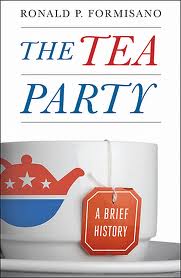
(Click for Amazon book review)
BOOK REVIEW by OnTheIssues.org:
This book is another in OnTheIssues.org's continuing series attempting to define the Tea Party (see list of Tea Party books at bottom of page). This book does a great job outlining the Tea Party's issue stances, in particular on social issues. Most analysts point out that the Tea Party really has no stances on social issues, since the movement is primarily devoted to economic issues. The author here instead cites polling data to describe where large majorities of Tea Partiers stand on one side or the other of social issues, or where they are mostly split.
The author's personal take on the Tea Party is not a purely positive analysis. He repeatedly describes the Tea Party as "astroturf," which means they receive funding from large organizations to pay for signature gatherers and event attendance. The term "astroturf" is a negative contrast to "grassroots," which means that Tea Partiers are self-motivated enthusiastic volunteers. The author does acknowledge the Tea Party's mix of astroturf funding and grassroots volunteerism.
The book outlines the history of the Tea Party including its historical reference to the 1700s Boston Tea Party (which evidently was not called that until decades later). The book also differentiates the Tea Party movement from its conservative cousins, the religious right and libertarians. The author notes for many candidates and members of Congress which received Tea Party support in addition to Christian conservative support, and which received Tea Party support without the religious right. The author differentiates libertarianism too, labeling most conservatives as preferring "Libertarianism With Benefits" (a charming term we believe this book coined).
The author's personal opinion on the Tea Party is exemplified by this excerpt: "The contemporary antitax climate is not hospitable to U.S. Supreme Court Justice Louis D. Brandeis's observation that taxes are the price we pay for civilization." (p. 105) Citing Brandeis usually indicates a progressive viewpoint; but in this context we'll assume the author is a mainstream observer of the Tea Party--this book is a solid outline from that perspective.
-- Jesse Gordon, jesse@OnTheIssues.org, May 2012
| OnTheIssues.org excerpts: (click on issues for details)
|
Civil Rights
Lynn Westmoreland: Display the Ten Commandments in public historical settings.
Michele Bachmann: Homosexuality is a dysfunction and reversible by prayer.
|
Environment
Paul LePage: OpEd: Pro-business assault on environmental regulations.
|
Government Reform
Paul LePage: Replaced same-day voter registration with photo ID rule.
|
Health Care
Joe Walsh: Opted out of Congress' health insurance plan.
|
Principles & Values
Tea Party: 2010: 52 Tea Party Caucus members among 87 GOP freshmen.
|
Tax Reform
Ross Perot: Increase taxes on the wealthy.
|
The above quotations are from The Tea Party:
A Brief History,
by Ronald Formisano.
Books about the Tea Party Movement:
- America the Beautiful, by Dr. Ben Carson, 2012
- The Second American Revolution, by the Tea Party Patriots, 2012
- The Remaking of Republican Conservatism, by Theda Skocpol & Vanessa Williamson, 2012
- An American Son, by Marco Rubio, 2012
- The Rise of Marco Rubio, by Manuel Rogi-Franzia, 2012
- The Tea Party: A Brief History, by Ronald Formisano, 2012
- Michele Bachmann: Why She Will Win, by Ron Paul Jones, 2011
- Core of Conviction, by Rep. Michele Bachmann, 2011
- Take the Risk, by Dr. Ben Carson, 2007
- The FairTax Book, by Rep. John Linder, 2006
- Give Us Liberty: A Tea Party Manifesto, by Rep. Dick Armey
- Troublemaker, by Christine O`Donnell
- The Tea Party Goes to Washington, by Sen. Rand Paul
- The Freedom Agenda, by Sen. Mike Lee
- Now Or Never, by Sen. Jim DeMint
|
|
|
Page last edited: Feb 25, 2019
|