
| |
Background on Crime
|
Crime topics in the 2020 election cycle:
Defund the police
1994 crime bill
Stop-and-frisk
- Stop-and-frisk:
A stop-and-frisk refers to a brief non-intrusive police stop of a suspect. The Fourth Amendment requires that before stopping the suspect, the police must have a reasonable suspicion that a crime has been, is being, or is about to be committed by the suspect. (Cornell)
- PRO-Stop-and-frisk:
A recording of Michael Bloomberg discussing his stop-and-frisk policy as New York City mayor surfaced online, saying the best way to reduce gun violence among minorities was to "throw them up against the wall and frisk them." (Bloomberg News )
- ANTI-Stop-and-frisk:
A federal judge found the New York City Police Department's "Stop-and-Frisk" policy unconstitutional. Overwhelming evidence suggests that the policy is used as a method of racially profiling and harassing Black and Latino citizens. In 1999, Blacks and Latinos made up 50% of New York's population, but accounted for 84% of the city's stops. (CivilRights.org)
- Three Strikes Laws:
‘Three Strikes’ mean that people convicted of a third felony receive a mandatory life sentence. The term refers to the baseball rule, "Three Strikes and You're Out." Some candidates advocate ‘Two Strikes’ or ‘One Strike,’ which generally means more mandatory sentencing, less judicial discretion, and less chance of early parole.
- Mitt Romney's term ‘One Strike’ is intended to be a stricter version of Three Strikes. This term, as well as "stop-and-frisk", have fallen out of favor since Romney's presidential run; "stop-and-frisk" was only revived in 2020 because of Mike Bloomberg's and Donald Trump's history.
- Joe Biden’s “Sentencing guidelines” are another form of mandatory sentencing (using legislative rules for sentencing instead of judicial discretion).
- TRUMP: Stop-and-frisk works in high-crime cities like Chicago (Oct 2018)
- BIDEN: NYC stop-and-frisk was stopped by Obama observers (Feb 2020)
- PENCE: Inner-city families should want stop-and-frisk (Oct 2016)
- HARRIS: Back on Track: expungement for first-time minor offenders (Jan 2019)
- BLOOMBERG: I was wrong to rely on stop-and-frisk policing (Nov 2019)
- GIULIANI: Stop-and-frisk policy made NYC safest big city (Oct. 2018)
- MITT ROMNEY: Favored mandatory sentencing and three strikes (Mar 2002)
- News on Three Strikes (Candidates' recent excerpts)
Gay panic defense
- Gay panic defense :
The gay/trans panic legal defense legitimizes and excuses violent and lethal behavior against members of the LGBTQ+ community. The defense is defined by the LGBT Bar as "a legal strategy which asks a jury to find that a victim's sexual orientation or gender identity is to blame for the defendant's violent reaction, including murder." (ABA)
- PRO-Gay panic defense :
Since the 1960s, the gay and trans panic defenses have appeared in court opinions in approximately one-half of the states. No state recognizes gay and trans panic defenses as free-standing defenses under their respective penal codes. (UCLA)
- ANTI-Gay panic defense : In 2013, the ABA approved a resolution urging governments to curb the use of the defense. Colorado will become the 11th state to outright ban the use of the gay/trans panic defense. (5280.com)
- TRUMP: Tolerate diversity; prosecute hate crimes against gays (Jul 2000)
- BIDEN: More funding and stricter sentencing for hate crimes (Apr 2001)
- PENCE: Voted NO on enforcing against anti-gay hate crimes (Apr 2009)
- HARRIS: I fought and ended the "gay panic" defense (Oct 2019)
- News on Hate Crimes (Candidates' recent excerpts)
Bail reform
- PRO-Bail reform: Money bail is a poor tool for achieving pretrial justice. The money bail system jails poor people because they are poor, not because they have been convicted of a crime and not because they are a danger to others. Meanwhile, that same system allows dangerous but wealthy people to post their bond and be released. (Harvard)
- ANTI-Bail reform: Bail has been a guarantor of the accused's liberty and public safety by creating stakes for the accused to fulfill their obligation to be adjudicated in our criminal justice system. The U.S. Supreme Court has explicitly ruled that the standard is not and cannot be "affordability." (Daily News)
- SANDERS: Bail reform: 65% of county & city inmates are "unconvicted" (May 2018)
- BLOOMBERG: End cash bail; $2.5 billion for public defenders (Jan 2020)
- HARRIS: Cash bail system favors the wealthy (Jan 2019)
Police Body cameras
- Police Body Cameras:
Body-worn cameras, which can be mounted on an officer's eyeglasses or chest area, offers real-time information when used by officers on patrol or other assignments that bring them into contact with members of the community. (NIJ)
- ANTI-Body Camera:
The ability to hold police departments accountable with body cameras often depends on rules designed by those same police departments. Evidence from outside sources--like witness cell phones and CCTV cameras--is often far more accessible to the public than body cam footage. (Wired)
- PRO-Body Camera:
Police body cameras improve police accountability and lower reports of police misconduct.
Police body cameras are a powerful tool in domestic violence cases. Police body cameras are a good police reform tool and have strong support from members of the public. (Enc.Brit)
- ANTI-Body Camera:
Police body cameras are too expensive and unreliable for many police departments. Police body cameras invade the privacy of citizens, potentially exposing victims and subjecting citizens to facial recognition software. Police body cameras decrease the safety of police officers and negatively affect their physical and mental health. (Enc.Brit)
- TRUMP: I've established law-and-order, except in Democrat cities (Sep 2020)
- BIDEN: Vast majority of police are ashamed of what they've seen (Aug 2020)
- PENCE: Require police to wear body cameras (Nov 2016)
- HARRIS: Don't require cops to wear body cameras (May 2015)
Central Park 5
- 1989 NYC case:
The Central Park 5 were five young teens (four black, one Latino) in 1989, when they were accused of beating and raping a woman who was jogging through Central Park. After their arrests, the five were violently interrogated and deprived of food and sleep, and they ultimately offered a coerced confession. The teenagers were exonerated by DNA evidence and a confession from the true perpetrator in 2002. (Vox.com)
- Trump on Central Park 5 in 1989:
After the five, were arrested, Trump took out a full-page ad in the local papers calling for the state to bring back capital punishment. "BRING BACK THE DEATH PENALTY. BRING BACK OUR POLICE!" Trump criticized the city for settling their civil case in 2014, calling the deal "a disgrace." (NBC News)
- TRUMP: Central Park 5 admitted guilt; exoneration doesn't matter (June 2019)
- BIDEN: Separate juveniles from adults in jail (Jul 2007)
First Step Act
Crime topics in the 2016 election cycle:
Black Lives Matter
The 'Black Lives Matter' movement attempts to get police to stop treating African-Americans differently than white suspects.
- The movement comes to the fore whenever a video emerges from a police shooting of black suspects, as has occurred regularly over the past years.
- Saying 'Black Lives Matter' blames the police for institutionalized racism, and demands corrective action by changing how police behave.
- The counter-movement uses the term 'Blue Lives Matter,' implying support of police in a dangerous job.
- Key cases in the BLM movement for 2020 include: George Floyd; Breonna Taylor, Ahmaud Arbery; Daniel Prude
The National Crime Victimization Survey found the lowest overall crime rate since the survey began in 1973.
Since 1994, violent crime rates have declined, reaching the lowest level ever recorded in 2010.
Property crime rates continue to decline as well.
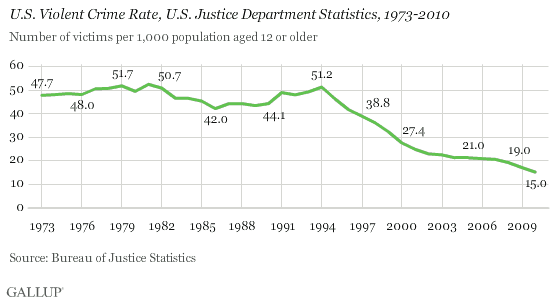
Despite the falling crime rate, taking into account both violent crime and property crime, 83 percent of Americans can expect to be a victim of crime at least once in their lifetime.
‘Prison-Industrial Complex’
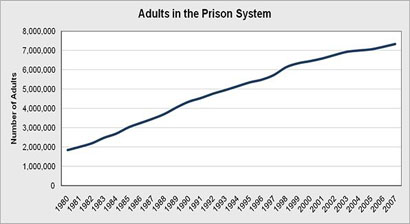
The opposite viewpoint from ‘Three Strikes’ focuses on the increasing prison population.
In this view, along with prison privatization, imprisonment has become big business, and hence subject to political pressure to increase imprisonment.
In particular, black males are ever more likely to be imprisoned.
 ‘Broken Windows’ Laws
‘Broken Windows’ laws mean that police focus on ‘quality of life’ issues as much as on crime itself. By addressing even minor crimes such as broken windows, according to this theory, a community is less likely to tolerate any crime, and overall crime rates should fall.
‘Community Policing’
‘Community Policing’ refers to a policy of crime prevention replacing incident response. It is often accompanied by a ‘broken windows’ policy, or by increased police presence on the streets.
Tort Reform
A ‘tort’ means a civil infraction as opposed to a criminal violation. ‘Tort reform’ includes capping lawsuit rewards; banning ‘frivolous lawsuits’; or some other change in civil lawsuit procedures.
Capital Punishment
The death penalty is currently implemented in 32 states (down from 34 in 2012). It was re-legalized by a Supreme Court decision in 1977. Since then, 1,392 people have been executed. About 3,000 inmates remain on ‘Death Row.’ Texas is by far the national leader in executions—it has executed 518 people as of November 2014, or 37% of the national total. (Oklahoma is a very distant second with 111). Florida is fourth, with 89 executions, but has 404 people on death row as of Nov. 2014 (only California has more, with 745).
Much of the current controversy about the death penalty focuses on the circumstances where it should be applied, and on its unequal application among racial and socioeconomic classes. About 52% of death row inmates are Black or other minority, versus 17% in the general population. Over 98% of death row inmates are male.
Hate Crimes
Congress defines ‘Hate Crimes’ as a crime in which the defendant intentionally selects a victim because of the actual or perceived race, color, national origin, ethnicity, gender, disability or sexual orientation of that person.
Hate Crimes are covered primarily as racial or anti-gay issues under Civil Rights.
Amendments V and VIII to the US Constitution
V. No person shall... be deprived of life, liberty, or property, without due process of law.... (1791)
VIII. Excessive bail shall not be required, nor excessive fines imposed, nor cruel and unusual punishments inflicted. (1791)
Related issues:
Drugs
Gun Control
Civil Rights
Click here for Amazon books on Crime.
Pro death penalty
Anti death penalty
Pro three strikes
Anti three strikes
Click here for references and citations books on Crime.
Brookings Institute, "What does 'defund the police' mean and does it have merit?," by Rashawn Ray, June 19, 2020
ACLU, "Defunding the Police Will Actually Make Us Safer," by Paige Fernandez, June 11, 2020
Potomac Local News, "Defunding the police is a bad idea," Letter to the Editor, June 14, 2020
Vox.com, "The controversial 1994 crime law that Joe Biden helped write, explained," by German Lopez, Sep 29, 2020
Cornell Law School, "Stop and frisk overview," by the Legal Information Institute, downloaded Oct.2020
Bloomberg News, "Michael Bloomberg Audio Emerges of His Stop and Frisk Defense," by Mark Niquette, February 11, 2020
CivilRights.org, "NYPD's Infamous Stop-and-Frisk Policy Found Unconstitutional," By Taahira Thompson, 08.21.2013
American Bar Association, "The Gay/Trans Panic Defense: What It is, and How to End It," by Alexandra Holden, Summer 2019
UCLA Law School, "Model Legislation for Eliminating the Gay and Trans Panic Defenses," September 2016
Mile-High Magazine, "Colorado Joins 10 Other States In Banning the Gay Panic Defense," by Daliah Singer, July 2, 2020
Harvard Law School, "Bail Reform: A Guide For State and Local Policymakers," by Colin Doyle, Chiraag Bains, & Brook Hopkins, February 2019
NY Daily News, "This bail reform is a bad idea," by Sean Kennedy, Mar 27, 2019
National Institute of Justice, "Body-Worn Cameras: What the Evidence Tells Us," by Brett Chapman, November 14, 2018
Wired Magazine, "Body Cameras Haven't Stopped Police Brutality," by Louise Matsakis, 06.17.2020
ProCon/Encyclopaedia Britannica, "Police Body Cameras: Top 3 Pros and Cons," 8/14/2020
Vox.com, "Trump still refuses to admit he was wrong about the Central Park 5," by Aaron Rupar, Jun 18, 2019
NBC News, "Trump digs in on Central Park 5," by Dareh Gregorian, June 18, 2019
Brennan Center, "What Is the First Step Act--And What’s Happening With It?," by Ames Grawert, June 23, 2020
Reason Magazine, "The FIRST STEP Act Has Reduced Prison Terms for More Than 7,000 People," by Jacob Sullum, 9.7.2020
|