|
|
Books by and about 2020 presidential candidates |
|
Crippled America,
by Donald J. Trump (2015) |
United,
by Cory Booker (2016) |
The Truths We Hold,
by Kamala Harris (2019) |
Smart on Crime,
by Kamala Harris (2010) |
Guide to Political Revolution,
by Bernie Sanders (2017) |
Where We Go From Here,
by Bernie Sanders (2018) |
Promise Me, Dad ,
by Joe Biden (2017) |
Conscience of a Conservative,
by Jeff Flake (2017) |
Two Paths,
by Gov. John Kasich (2017) |
Every Other Monday,
by Rep. John Kasich (2010) |
Courage is Contagious,
by John Kasich (1998) |
Shortest Way Home,
by Pete Buttigieg (2019) |
The Book of Joe ,
by Jeff Wilser (2019; biography of Joe Biden) |
Becoming,
by Michelle Obama (2018) |
Our Revolution,
by Bernie Sanders (2016) |
This Fight Is Our Fight,
by Elizabeth Warren (2017) |
Higher Loyalty,
by James Comey (2018) |
The Making of Donald Trump,
by David Cay Johnston (2017) |
|
Books by and about the 2016 presidential election |
|
What Happened ,
by Hillary Clinton (2017) |
Higher Loyalty ,
by James Comey (2018) |
Trump vs. Hillary On The Issues ,
by Jesse Gordon (2016) |
Hard Choices,
by Hillary Clinton (2014) |
Becoming ,
by Michelle Obama (2018) |
Outsider in the White House,
by Bernie Sanders (2015) |
|
|
Book Reviews |
(from Amazon.com) |
(click a book cover for a review or other books by or about the presidency from Amazon.com)
|
Known and Unknown
A Memoir
by Donald Rumsfeld
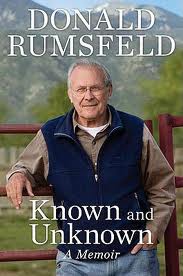
(Click for Amazon book review)
OnTheIssues.org BOOK REVIEW:
Donald Rumsfeld famously said in a 2002 press interview, "There are known knowns; there are things we know we know. We also know there are known unknowns; that is to say we know there are some things we do not know. But there are also unknown unknowns--the ones we don't know we don't know."
That confused many members of the press, and many concluded that Rumsfeld was just toying with the press. The title of Rumsfeld's memoir would seem to continue Rumsfeld's making fun of the press. Some have defended Rumsfeld's 2002 statement as brilliant rather than mocking, so perhaps Rummy is just pointing out with the title "Known and Unknown" that most of us are just too dumb to get it.
We found one "unknown unknown" in this book of great interest. Rumsfeld reports (p. 448) that in 2003, the US Army entered Khurmal, Iraq, and confirmed an already-known WMD facility (constructing Weapons of Mass Destruction): "By then, much of the facility had been destroyed by cruise missile strikes and fighting on the ground, but clear signs of chemical weapons production were found, including chemical hazard suits, manuals to make chemical weapons in Arabic, and traces of the deadly toxins cyanide, ricin, and potassium chloride." We're unclear if this is a new revelation in this book, but an Internet search of the term "Khurmal" yields only refutations that it contained no WMD facility.
Since WMDs in Iraq were Pres. Bush's primary rationale for the invasion of Iraq, and since "Khurmal" was cited by Colin Powell in his UN speech encouraging the Iraq invasion, this would seem to be a key piece of evidence. Had this piece of information been made public, Americans would have to say that, indeed, Pres. Bush had been right all along, instead of the current conclusion that the rationale for invasion was mistaken. So why would the Bush administration not reveal this key evidence? Rumsfeld concludes: "For whatever reason, the administration never made public these facts about an active WMD production facility run by terrorists in Iraq."
Huh? I find that passage as confusing as Rumsfeld's famous 2002 statement. I'm unclear if Rumsfeld is contending that Saddam had WMD after all. Rumsfeld says (p. 449), "Powell was not duped or misled by anybody, nor did he lie about Saddam's suspected WMD stockpiles. The President did not lie. The Vice President did not lie. Rice did not lie. I did not lie. The Congress did not lie. The far less dramatic truth is that we were wrong."
Huh, again? Wrong about what? If the war rationale about WMD was wrong, then what was the Khurmal passage about? And what was at Khurmal then? There are just so many unknown unknowns here -- I must be too dumb to get it!
-- Jesse Gordon, editor-in-chief, OnTheIssues.org, November 2011
| OnTheIssues.org excerpts: (click on issues for details)
|
Budget & Economy
Gerald Ford: 1974: Whip Inflation Now, "WIN", became national punch line.
|
Civil Rights
Donald Rumsfeld: 1972: favor diversity but no racial quotas.
|
Education
Donald Rumsfeld: 1969: Experiment with school vouchers.
Milton Friedman: 1969: Experiment with school vouchers.
|
Foreign Policy
Condoleezza Rice: 2001 Uzbekistan: Human rights trump security.
John F. Kennedy: Thin foreign policy record from all-too-short presidency.
John McCain: 2001: Publicly rebuke Uzbekistan for human rights violations.
Ronald Reagan: 1982:Disagreed with Law of the Sea's international authority.
|
Health Care
Donald Rumsfeld: Big Pharma's R&D investment is underappreciated.
|
Homeland Security
Donald Rumsfeld: 1972: All-volunteer military by paying competitive salary.
Milton Friedman: 1972: Passionate proponent of all-volunteer military.
Ted Kennedy: 1972: Favored continuing the draft.
|
Principles & Values
Donald Rumsfeld: Rumsfeld's Rules: for business and government.
Lyndon Johnson: 1960 JFK slogan: "Let us begin"; 1964 LBJ: "Let us continue".
Richard Nixon: 1962: "You won't have Nixon to kick around anymore".
|
Tax Reform
Bob Dole: 1995: 15% across-the-board tax cut to stimulate economy.
Donald Rumsfeld: 1995: 15% across-the-board tax cut to stimulate economy.
Milton Friedman: 1995: 15% across-the-board tax cut to stimulate economy.
Steve Forbes: 1995: 15% across-the-board tax cut to stimulate economy.
|
War & Peace
Colin Powell: 1991: continuing conflict into Baghdad would be un-American.
Donald Rumsfeld: 1965: voted for additional $700M for Vietnam War.
George Bush Sr.: 1991: continuing conflict into Baghdad would be un-American.
Lyndon Johnson: 1965: requested additional $700M for Vietnam War.
|
The above quotations are from Known and Unknown
A Memoir
by Donald Rumsfeld.
Autobiographies for 2012 GOP primary candidates:
- Bloomberg by Bloomberg, by Mike Bloomberg, Aug 10, 2001
- Never Give Up, by Donald Trump, Jan, 2008
- Pour Your Heart Into It, by Howard Schultz, 1999
- Where The Right Went Wrong, by Pat Buchanan, Aug. 2004
Biographies:
- The 100 Greatest Speeches, by Simon Maier & Jeremy Kourdi, 2010
- Give Us Liberty: A Tea Party Manifesto, by Rep. Dick Armey, 2010
- The Battle for America 2008, by by Dan Balz and Haynes Johnson, 2009
Policy books:
- Known and Unknown, by Donald Rumsfeld, Feb. 2011
- Suicide of a Superpower, by Pat Buchanan, Oct. 2011
- Saving Freedom, by Jim DeMint, July 2009
- Pigs at the Trough, by Arianna Huffington, 2004
- Right Is Wrong, by Arianna Huffington, 2008
|
|